
Why Are My Lights Flickering?
Few electrical problems create more anxiety than flickering lights.
Most homeowners immediately jump to one of two conclusions:
It's nothing.
The house is about to burn down.
The truth is usually somewhere in the middle.
Sometimes flickering lights are completely normal. Other times they're warning signs that something in your electrical system needs attention.
Let's break down some of the most common causes.
Sometimes It's Completely Normal
One of the most common reasons for brief light dimming is a large appliance turning on.
Your air conditioner starts.
Your microwave kicks on.
Your well pump starts running.
Your electric water heater cycles on.
These loads draw a significant amount of current, and it's normal to see a slight change in brightness when they start.
In many homes, lights and appliances share the same phase of the electrical system. When a large load turns on, the voltage can dip slightly for a moment before stabilizing.
If the lights dim briefly and consistently when a specific appliance starts, that doesn't automatically mean something is wrong.
Sometimes it's just physics doing physics things.
Loose Light Bulbs and Fixtures
Before assuming the worst, check the simple stuff.
A loose bulb, worn socket, or failing light fixture can cause flickering that appears far more serious than it actually is.
If only one fixture flickers while everything else in the house remains normal, the problem is often local to that fixture.
Loose Connections
This is where things can start becoming more serious.
Loose electrical connections create resistance.
Resistance creates heat.
Heat creates problems.
A loose connection may cause lights to flicker intermittently, especially when electrical loads change throughout the house.
These issues can occur at:
Switches
Receptacles
Wire splices
Light fixtures
Electrical panels
Meter bases
Service equipment
Unlike a loose light bulb, loose electrical connections rarely improve with age.
Neutral Problems
One of the most common causes of widespread flickering is a loose or failing neutral connection.
Your home's electrical system operates using two hot legs and a neutral conductor.
When the neutral connection becomes loose or damaged, voltage can become unbalanced throughout the home.
The symptoms can be strange:
Some lights get brighter.
Some lights get dimmer.
Flickering occurs throughout the house.
Problems appear worse when appliances are running.
This is one of those situations where calling an electrician sooner rather than later is usually a good idea.
Problems Outside the House
Sometimes the issue isn't inside your home at all.
We've found flickering caused by:
Loose service connections
Damaged service conductors
Corroded meter bases
Utility transformer issues
Utility neutral problems
In those situations, the problem may involve your utility company as much as your home's electrical system.
Found in the Wild
Not all flickering is subtle.
This photo shows a service connection that had become severely overheated.
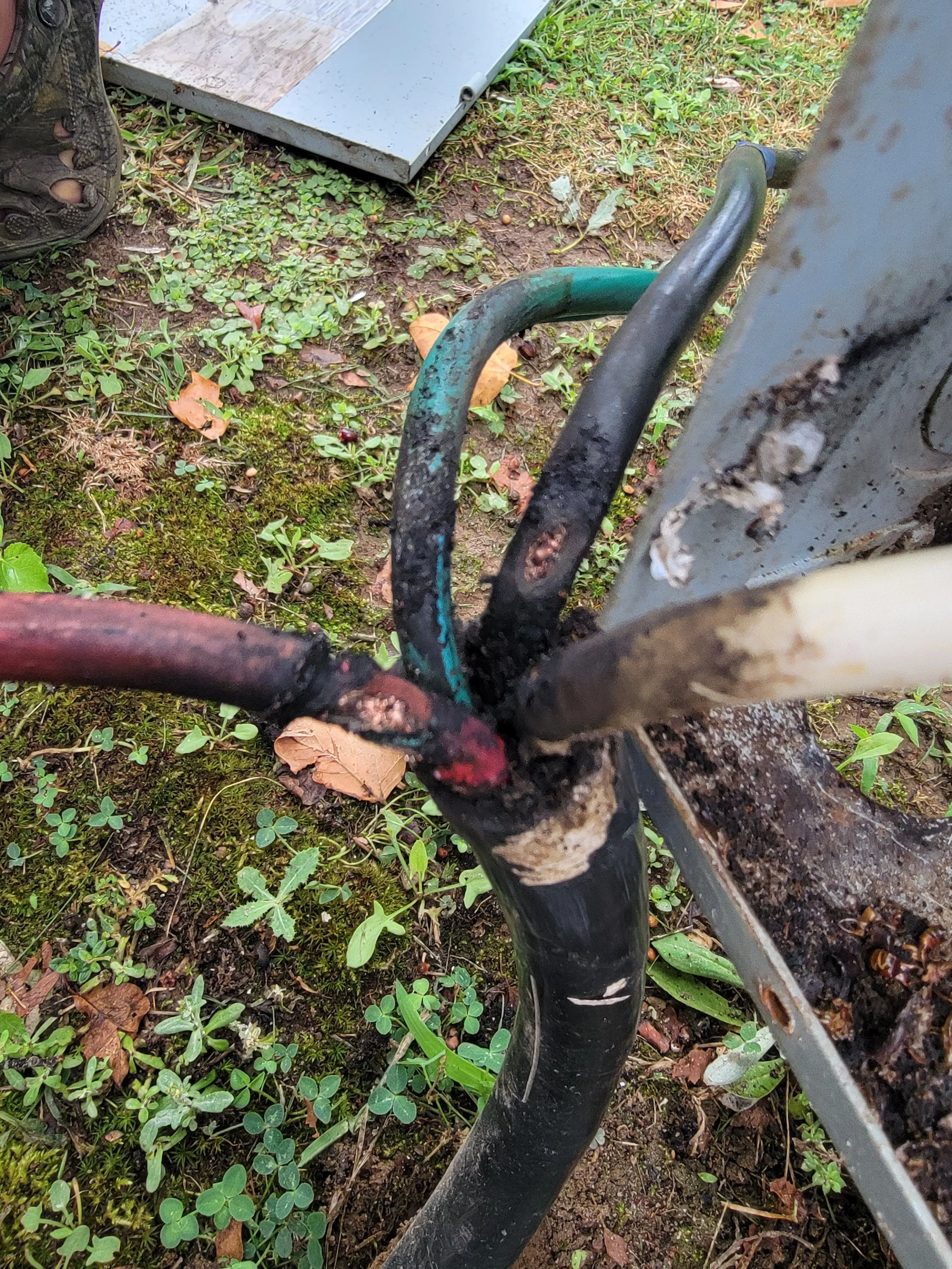
Damaged insulation, burned conductors, and deteriorated connections like these can create voltage fluctuations, intermittent power problems, and potentially much more serious hazards.
By the time lights start flickering from a connection this bad, the electrical system is usually trying very hard to get someone's attention.
Sometimes flickering lights are the symptom.
The actual problem is hiding somewhere else entirely.
So When Should You Be Concerned?
It's worth investigating if:
Multiple lights throughout the home flicker
Lights become brighter and dimmer unexpectedly
Flickering affects multiple circuits
You hear buzzing sounds
You smell burning odors
Breakers trip frequently
The flickering is getting worse over time
The Bottom Line
Flickering lights don't automatically mean you need a new panel.
They don't automatically mean your house is unsafe.
And they don't automatically mean you should ignore the problem.
Sometimes it's a microwave.
Sometimes it's a loose connection.
Sometimes it's a utility issue.
And sometimes it's a melted service conductor quietly trying to start a conversation.
The trick is figuring out which one you're dealing with.
Stay legendary.
