
Why Does My Breaker Keep Tripping?
If your breaker keeps tripping, the good news is:
It's probably doing its job.
Circuit breakers are designed to shut off power when they detect a problem. While it can be frustrating when the lights go out or the microwave suddenly stops working, a breaker that trips is often a sign that your electrical system is protecting itself.
The real question isn't:
"Why won't this breaker stay on?"
The real question is:
"What is the breaker trying to tell me?"
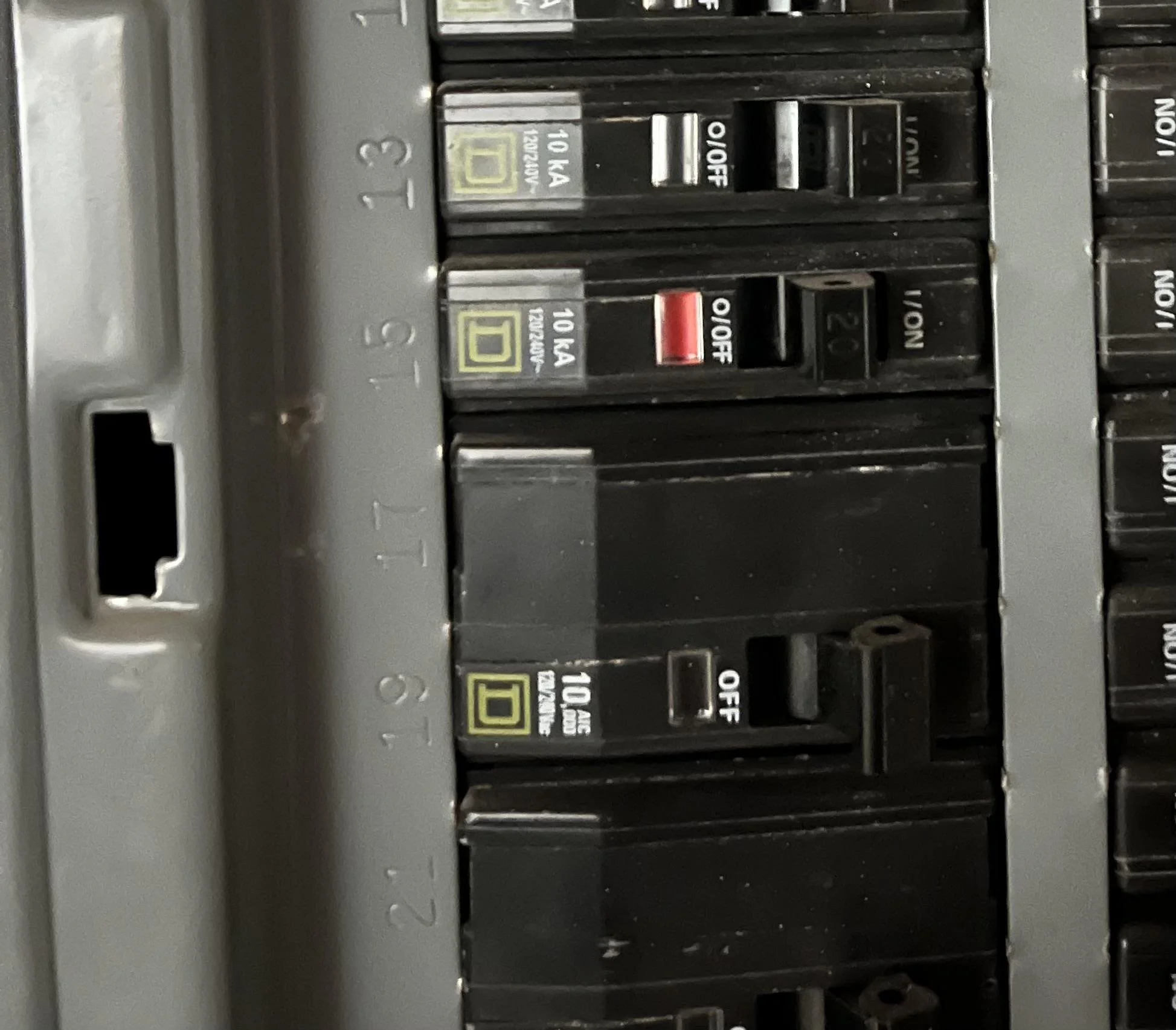
The Most Common Cause: Overloaded Circuits
This is by far the most common reason we see breakers trip.
Every circuit in your home has a limit to how much electricity it can safely carry.
When too many devices are running at the same time, the breaker shuts off power before the wiring overheats.
Common examples include:
Space heaters
Air fryers
Microwaves
Hair dryers
Window air conditioners
Portable heaters
Individually, these appliances may be perfectly fine.
The problem is when several of them end up sharing the same circuit.
If the breaker only trips when multiple devices are running, overloading is often the culprit.
Short Circuits
A short circuit occurs when electricity takes an unintended path.
This can happen because of:
Damaged wires
Faulty appliances
Loose connections
Damaged cords
Short circuits often cause a breaker to trip instantly.
In some cases, you may see a spark, hear a pop, or notice a burning smell.
If that happens, it's worth investigating sooner rather than later.
Ground Faults
Ground faults occur when electricity escapes its intended path and travels somewhere it shouldn't.
Often that's through metal parts, water, or grounded surfaces.
This is exactly why GFCI protection exists.
Bathrooms, kitchens, garages, crawl spaces, basements, and outdoor receptacles are especially common locations for ground faults.
Sometimes the problem is a faulty appliance.
Sometimes moisture has found its way where it doesn't belong.
AFCI Breakers: The "Nothing Is Wrong" Breaker
AFCI breakers can be confusing.
They are designed to detect electrical arcing that may occur long before a traditional breaker would trip.
Sometimes they identify legitimate problems.
Sometimes they identify issues hidden inside appliances, extension cords, switches, or wiring that otherwise appear normal.
The homeowner's experience usually sounds something like:
"Nothing is wrong, but the breaker keeps tripping."
Sometimes the breaker disagrees.
The Breaker Could Be Bad
It happens.
While breakers are generally reliable, they are mechanical devices.
Like anything mechanical, they can wear out.
A breaker that trips repeatedly for no obvious reason may need testing or replacement.
The good news is this is far less common than overloaded circuits or wiring problems.
The Problem May Not Be the Circuit
Sometimes the breaker is simply the messenger.
We've seen tripping caused by:
Loose panel connections
Corroded terminals
Damaged wiring
Failing appliances
Water intrusion
Improper DIY modifications
Replacing the breaker doesn't solve any of those problems.
It just changes who gets blamed.
What Should You Do?
Start by paying attention to patterns.
Ask yourself:
What was running when the breaker tripped?
Does it happen every time?
Is it one circuit or multiple circuits?
Has anything recently been added or changed?
Those clues often point us toward the cause very quickly.
What You Shouldn't Do
Don't replace a breaker with a larger breaker simply because it keeps tripping.
And please don't hold it on with tape, zip ties, determination, or positive thinking.
The breaker is sized to protect the wiring connected to it.
Making the breaker bigger doesn't make the wiring bigger.
It just removes one of the safety devices protecting yourhome.
The Bottom Line
Most breakers trip for a reason.
Sometimes that reason is harmless.
Sometimes it's inconvenient.
Sometimes it's a warning sign that deserves attention.
The trick isn't forcing the breaker to stay on.
The trick is figuring out why it wanted to turn off in the first place.
Stay legendary.
